In the fast-paced business environment of the Dallas-Fort Worth Metroplex, technology evolves faster than most infrastructure can keep up. What was considered “high speed” five years ago is often the bottleneck of today. For forward-thinking companies, from tech startups in the Richardson Telecom Corridor to logistics hubs in Fort Worth, investing in infrastructure isn’t just about meeting today’s needs; it’s about anticipating tomorrow’s demands.
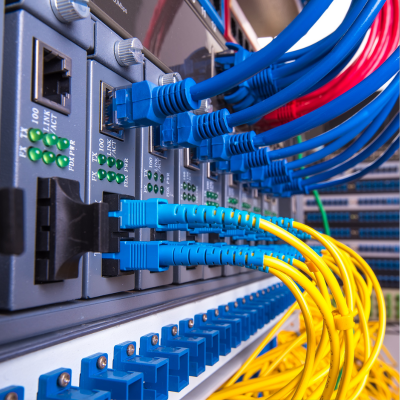
While traditional copper cabling (Cat6) remains a staple for desktop connections, Fiber Optic cabling has emerged as the gold standard for backbone infrastructure. It offers bandwidth, speed, and reliability that copper cannot match.
This guide explores why upgrading to fiber is one of the most effective ways to future-proof your business operations against rising data demands.
The Bandwidth Explosion: Preparing for the Cloud Era
Ten years ago, a 100 Mbps connection was a luxury. Today, with the widespread adoption of cloud computing, 4K video conferencing, and heavy data analytics, it is a baseline requirement.
Copper cabling has physical limitations. As data transmission speeds increase, the distance copper can carry that signal decreases. Fiber optics, however, uses light pulses rather than electrical signals, enabling virtually unlimited bandwidth.
By integrating fiber optic cabling into your network backbone now, you ensure that your facility is ready for the next generation of bandwidth-hungry applications without requiring a costly “rip and replace” renovation in a few years.
Distance and Durability: Solving the Warehouse Challenge
For industrial clients, such as those operating sprawling distribution centers in Grand Prairie or Mesquite, distance is a major enemy of network performance.
Standard copper cable (Cat6) has a hard distance limit of 328 feet (100 meters). Additionally, signal loss occurs, resulting in slow connections and dropped packets. Fiber-optic cabling eliminates this constraint, enabling high-speed signals to be carried over thousands of feet.
- Multimode Fiber: Ideal for interconnecting servers and switches within a large building or campus environment.
- Single-mode Fiber: Perfect for long-haul connections between separate buildings in a business park.
This capability makes fiber the essential choice for connecting remote IDF cabinets to the main server room, ensuring that a barcode scanner at the back of a warehouse operates as quickly as a computer in the front office.
Reliability and Security: Immune to Interference
Data integrity is critical. In environments with heavy machinery, elevators, or HVAC units, copper cabling can act as an antenna, picking up Electromagnetic Interference (EMI) that disrupts data flow.
Because fiber optics transmits data via light, the signal is completely immune to electrical interference. This makes it the only logical choice for manufacturing plants or hospitals where reliable data transmission is critical to safety.
Furthermore, fiber is significantly more secure. Unlike copper, which can be “tapped” by reading the electromagnetic field around the wire, fiber emits no signals. Intercepting data requires physically cutting the glass strand, which immediately breaks the connection and alerts network administrators. For businesses handling sensitive client data in Plano or Frisco, this added layer of physical security is a major asset.
Total Cost of Ownership vs. Upfront Cost
The most common hesitation among businesses about fiber is the upfront installation cost. It is true that the electronics (transceivers) and fiber termination labor are higher than for standard copper.
However, when viewed as a 10-to-15-year investment, fiber often offers a lower Total Cost of Ownership (TCO).
- Longevity: Fiber is durable and does not degrade as quickly as copper in harsh environments.
- Scalability: When network speeds jump from 10Gbps to 40Gbps or 100Gbps, you usually only need to upgrade the electronics at the ends of the fiber, not the cable itself.
Investing in a robust, structured cabling design that utilizes fiber backbones minimizes the risk of expensive downtime and premature obsolescence.
Secure Your Business’s Digital Future
Technology will only get faster. Ensure your building is ready to handle it. Z-Tech Communications helps DFW businesses design scalable, high-performance networks that stand the test of time.
Ready to upgrade your infrastructure?
Contact Z-Tech Communications today to discuss how a fiber optic backbone can transform your network reliability.
Frequently Asked Questions
Is fiber optic cabling too expensive for small businesses?
Not necessarily. While wiring an entire office with fiber to every desk (Fiber-to-the-Desktop) is cost-prohibitive for most, using fiber for the backbone (connecting your internet entry point to your server rack, or linking two switches) is highly affordable and provides a massive performance boost.
Can I mix fiber and copper cabling?
Yes, this is the standard approach for 99% of businesses. We typically install fiber optic cable to link the main server room to satellite closets, and then run standard copper Cat6 cabling from those closets to individual workstations and VoIP phones. This offers the “best of both worlds”—the speed of fiber and the affordability of copper.
Is fiber optic cable fragile?
The glass strands inside are delicate, but the outer jacketing is incredibly tough. Modern armored fiber is rugged enough to withstand rodent chews, crushing, and harsh weather conditions. We frequently install armored fiber for outdoor runs or industrial clients in Fort Worth.
Does Z-Tech perform fiber fusion splicing?
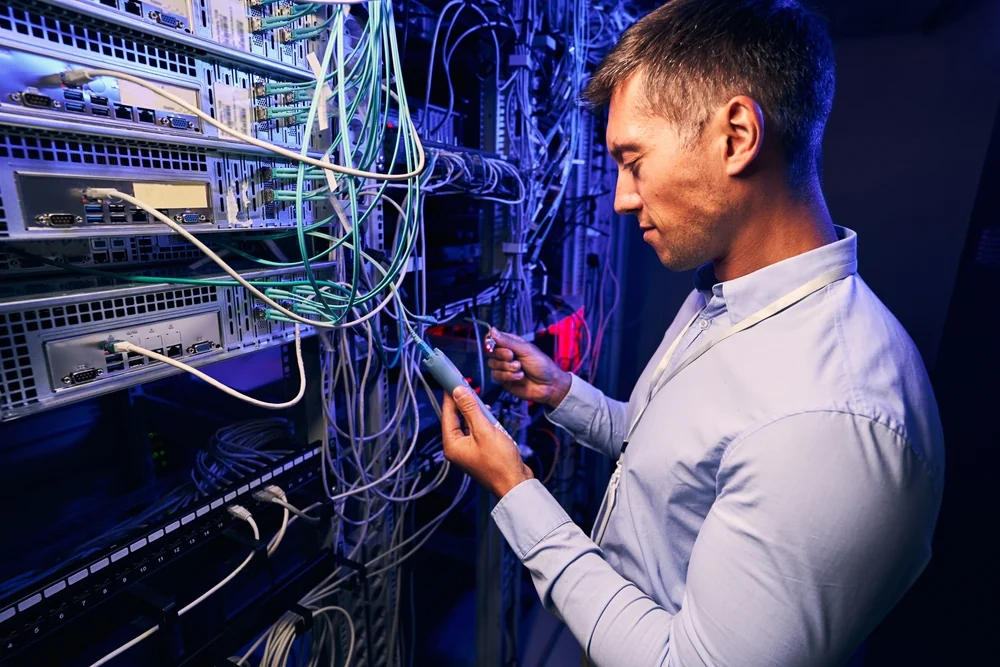
Yes. Proper termination is critical for fiber performance. We use precision fusion splicing to join fiber strands, ensuring minimal signal loss. Whether you need a repair on a cut line or a new installation in Irving, our technicians are equipped with the latest splicing tools.