For business owners in the Dallas-Fort Worth Metroplex, network speed is often a top priority, but the jargon can be confusing. When planning a move to a new office in Plano or upgrading a warehouse in Grand Prairie, you will likely face a choice between Cat6, Cat7, and Fiber Optic cabling.
While higher numbers usually imply better performance, the reality of structured cabling is more nuanced. Choosing the “highest number” often leads to overspending on a standard that your equipment cannot use.
This guide compares these three cable types to help you decide which infrastructure is the right fit for your operations.
Cat6: The Industry Standard for Business
For 90% of commercial offices, Cat6 is the most practical and cost-effective choice. It is the current industry standard for Gigabit Ethernet and can handle typical office tasks, VoIP phones, cloud access, and video conferencing with ease.
- Speed: 1 Gbps up to 328 feet (100 meters); can support 10 Gbps at shorter distances (up to 165 feet).
- Best For: General office spaces, retail stores, and medical clinics.
- Cost: The most affordable option for material and labor.
If you are leasing a corporate suite and need reliable structured cabling in Dallas, Cat6 is likely your sweet spot. It provides ample speed without the premium price tag of specialized shielding.
Cat7: The Misunderstood “Middle Child”
Cat7 is frequently requested by business owners looking for “the best,” but it is often a misunderstood standard. Unlike Cat6 or the newer Cat8, Cat7 is not recognized by the TIA/EIA (the US body that sets cabling standards).
Cat7 was designed with heavy shielding to reduce interference and, in theory, support higher speeds. However, to achieve Cat7 performance, you cannot use standard RJ45 connectors (the plastic plugs you see everywhere); you must use specialized non-standard connectors (such as GG45 or TERA).
- The Reality: Most “Cat7” installs end up being a hybrid that doesn’t fully meet the spec because they use standard equipment.
- The Better Alternative: If your business needs speeds faster than Cat6 (for example, 10 Gbps for large file transfers), we typically recommend Cat6A. It is a recognized standard, fully compatible with your existing servers, and excellent for high-performance environments like tech startups in Frisco or data centers in Richardson.
Fiber Optic: The Long-Distance Champion
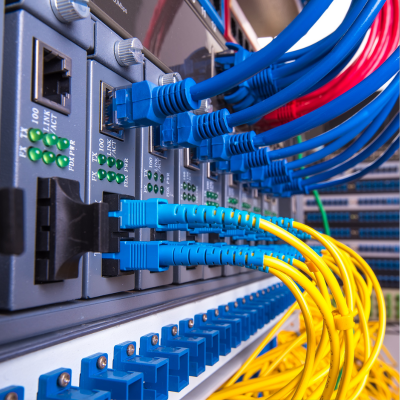
While copper (Cat6/Cat7) uses electricity to transmit data, Fiber Optic cables use pulses of light. This makes them immune to electrical interference and capable of transmitting data over long distances without degrading performance.
- Speed: 10 Gbps, 40 Gbps, and beyond (virtually limitless bandwidth).
- Distance: Can run for miles, unlike copper, which tops out at 328 feet.
- Best For: Connecting separate buildings, large warehouses, or manufacturing plants with heavy machinery.
For example, if you manage a sprawling industrial facility in Mesquite, running copper wire from one end to the other is impossible due to distance limits. In this case, installing fiber optic cabling creates a high-speed “backbone” that links your different departments together seamlessly.
Quick Comparison: Speed, Distance, and Cost
| Feature | Cat6 | Cat7 | Fiber Optic |
| Primary Use | Standard Office / Retail | Specialized Shielding | Long Distance / Backbone |
| Max Speed | 1 Gbps (10 Gbps @ 55m) | 10 Gbps | 100 Gbps+ |
| Max Distance | 100 Meters (328 ft) | 100 Meters (328 ft) | Miles |
| Interference | Low | Very Low | Immune (None) |
| Cost | $ | $$$ |
Which Cabling Should You Choose?
Choose Cat6 if:
- You are occupying a standard office space or retail location.
- Your primary needs are internet browsing, VoIP, and cloud-based software access.
- You want the most cost-effective solution that is easy to maintain.
- See our work in Plano for examples of standard office build-outs.
Choose Cat6A (instead of Cat7) if:
- You transfer massive files daily (e.g., video editing, engineering firms, and medical imaging).
- You are in a building with high electrical interference.
- You want to “future-proof” your network for the next 10-15 years without dealing with non-standard Cat7 connectors.
Choose Fiber Optic if:
- You need to connect two separate buildings (e.g., a campus or outdoor facility).
- Your cable runs are longer than 300 feet (common in large warehouses).
- You are upgrading data cabling services and need a high-speed backbone to link your server room to different parts of the building.
Get a Custom Assessment for Your Business
Every building in the DFW area has unique architecture and power requirements. Don’t guess which cable you need; let us verify it on-site.
Ready to upgrade?
Contact Z-Tech Communications today for a free site survey and a clear, jargon-free recommendation for your business.
Frequently Asked Questions
Is Fiber Optic cabling better than Cat6?
They serve different purposes. Fiber is “better” for speed and distance, but it is too expensive and complex to plug directly into every employee’s laptop. A balanced network usually uses Fiber for the main backbone and Cat6 for individual desks.
Can I use Cat7 cable with a normal router?
Yes, but you likely won’t see a performance increase over Cat6A. If you use standard plugs on Cat7 cable, you lose the specific shielding benefits that make Cat7 unique.
Do you install cabling for warehouses?
Yes. We specialize in industrial environments, often utilizing a mix of fiber (for distance) and copper (for wireless access points). We frequently support logistics hubs in Fort Worth and Grand Prairie.